Started Car and Lights Were Dim Then Wont Start Again
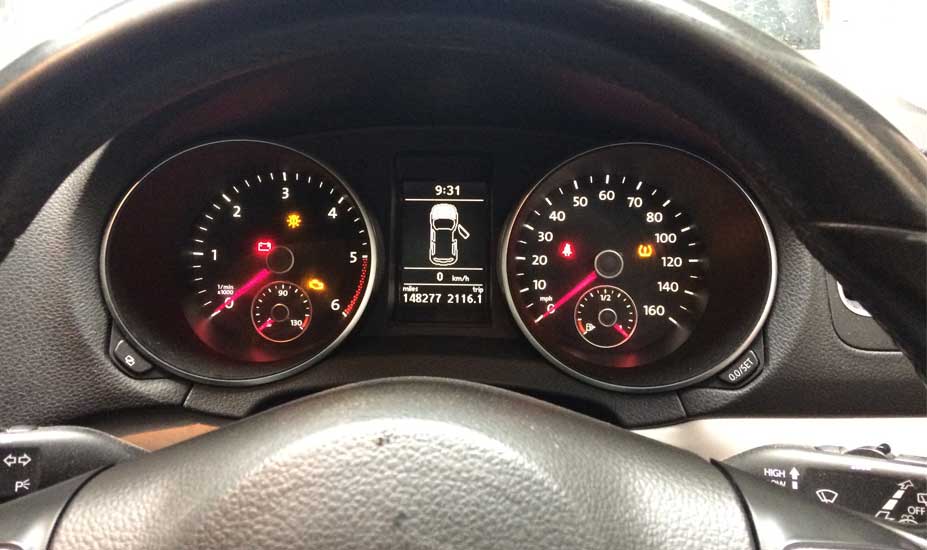
There'due south never a good time to break downwardly. Information technology'south e'er inconvenient and sometimes stressful. So let'south see if we can figure this out with the minimum amount of fuss.
And so, why won't your machine start even though the lights come on? The most probable fault is a flat bombardment, but here are 10 other possible causes:
- Faulty bombardment
- Loose dirty or damaged battery connections
- Key code error
- Clutch / Park lock out switch
- Blown main fuse
- Faulty starter relay
- Loose / damaged starter wiring circuit
- Faulty starter
- Faulty ignition switch
- Mechanical fault

In nearly cases, it's a battery-related fault, and so we'll run a few quick tests that will aid us narrow down the field of possible causes.
If your automobile is younger than 1996, it'll be fitted with a information link connector. Using a lawmaking reader will help speed up diagnoses.
Using Our Ears
A few simple observations can exist made without any tools, only our ears.
- Does your car brand a repeating clicking noise, or a unmarried click noise, when the cardinal is turned to creepo (start). If then your bombardment is virtually probable flat, simply it could likewise advise a faulty starter motor.
- If your car makes no racket at all when the key is turned to crank (commencement) – this may also be caused by a flat bombardment an activated Inertia switch is common also. The list of possibles causes is much larger and nosotros'll cover the mutual one'due south below.
Checking For Apartment Or Faulty Battery

Frequently modern cars volition have working lights and yet the engine won't crank over, and that's because modern cars have battery management software built into the engine control module. In evidently English, this means the ignition won't endeavour to appoint the starter motor if the bombardment is low.
A quick mode to examination your battery is to turn on your car headlights and your windshield wipers at full speed. If the lights seem dim and the wipers are ho-hum, and so you can be pretty certain your battery is flat.
A flat battery is easy to gear up. You lot tin boost start (jump-get-go) your car from another auto or any 12 volt battery that's stiff enough. This is the fastest solution to a flat battery.
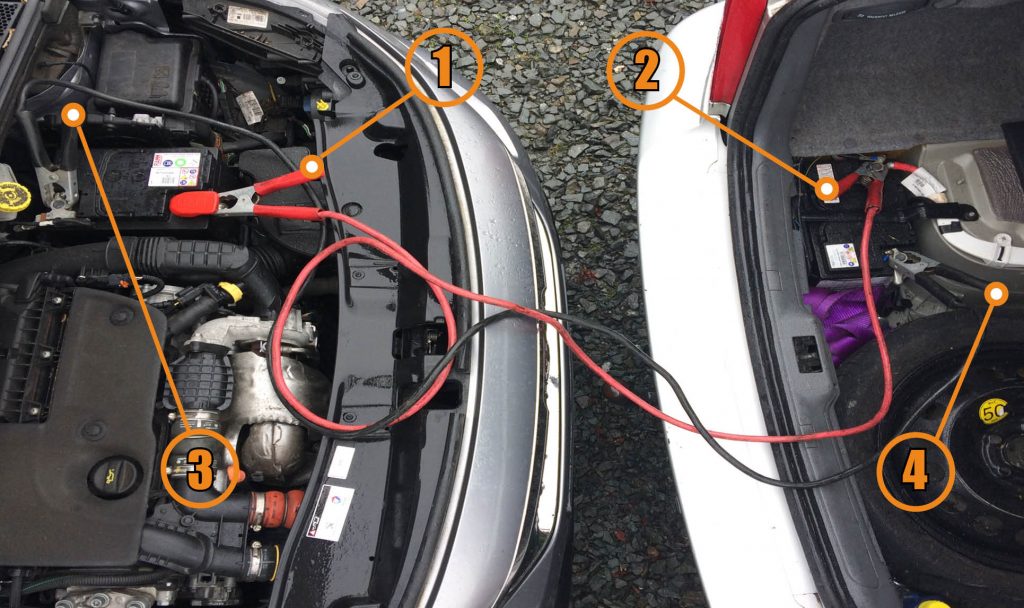
Jump starting is simple, connect the cerise positive (+) to scarlet positive and negative black (-) to negative.
Using the picture beneath as a guide, put the jumper cables on in sequence 1, 2, three, 4. (Information technology's not important which car has the apartment bombardment)
Start your motorcar and leave the cables attached and your car idling for a few minutes before removing.
At present with the engine running, remove the cables in reverse order 4, iii, ii, and 1.
Another option is to charge the battery. Withal, this may have several hours, depending on the size of the battery and the amp rating of the charger used.
The battery may exist more than just flat. Information technology may be faulty. Ordinarily, a jump-started car will stay running, even with a faulty battery, but if y'all run likewise many consumers like heaters, wipers, and lights, the engine will stall.
Testing bombardment
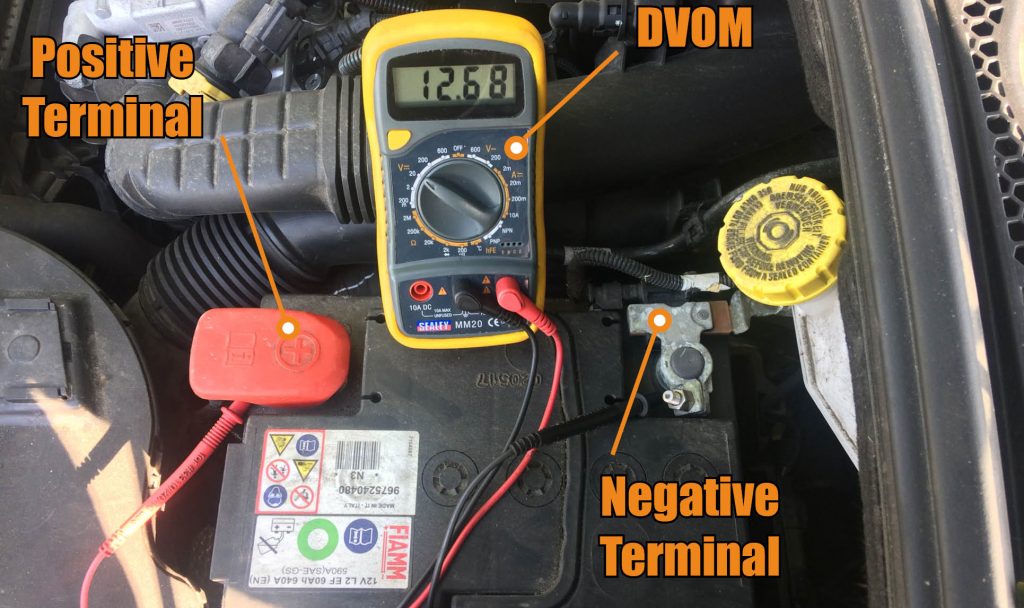
Testing the battery is easy. Yous can purchase an inexpensive battery testing tool. Testing the battery is a two-part process. Nosotros'll get-go test the voltage and and then check the battery when loaded.
Battery Voltage test
The following readings represent the state of charge of a battery at rest:
- 12.7 – xiii.2 volts is 100% charged
- 12.4 volts is 75% charged
- 12.2 volts is 50% charged
- 12.0 volts is 25% charged
- 0 – xi.9 volts is Discharged (Flat)
A battery could read a healthy 12.65 volts and even so be faulty, so nosotros demand to load examination it to be sure information technology'south got the ability to plow the engine.
Battery load exam
To execute this examination, we'll need a helper and our DVOM. Connect the meter as per the diagram below and have the helper creepo over the engine. A battery that drops below nine volts on a crank is faulty.
If bombardment voltage doesn't motion when the ignition is turned to the crank (get-go) position, your battery isn't at error.

If you need a new battery, cheque out the Amazon automobile battery link below.
Amazon Car Battery
Checking For Loose / Dirty Or Faulty Battery Connections

As you probably know, voltage moves effectually in a circuit. Whatsoever break or defect in the circle of menses will cause issues. Often intermittent electrical bug are caused by dirty or weak battery connections.
Acrid corrosion on the battery terminals is common. It looks like a white/green chalky deposit. This creates a blockage in the menses of the battery current.
Using baking soda and some water is the best fashion to naturalize it. The bombardment connections and terminals will demand to exist cleaned with sandpaper or a battery post cleaner.
A battery cable is actually made upwardly of several individual wires twisted and covered in an insulator. Engine vibration can cause some of the individual wires to break, which in turn, just like corrosion, tin cause a slowdown of current through the wire, not unlike a traffic jam.
Cheque both positive and negative bombardment terminals are tight, leads, cables, and connections are gratuitous from damage and corrosion.
The best test for bombardment cables is the volt driblet test. Don't worry this is uncomplicated. The test basically measures the difference in voltage between the 2 split exam points, a large voltage difference tells y'all there's a blockage in the organization.
A blockage could be broken wires, bad connections chafing wires, etc.
For this test, you'll need a voltmeter, and it will merely be accurate if the circuit is loaded (key in the crank position).

Checking Your Car Security System

Check your dashboard for a security warning calorie-free. Virtually cars made in the terminal twenty years use a security chip in the ignition central. The bit is coded to the engine control module and is read by the ignition switch lawmaking reader.
If the wrong fundamental is used or the chip isn't being read, the ignition lights will come on but the engine won't turn over.
Cardinal chips sometimes go bad as do the ignition central code readers. Almost cars volition flash a alert light on the nuance if in that location'southward a trouble with the security arrangement.

If you have a security lawmaking or a key warning calorie-free on your dashboard, y'all'll demand to visit the main dealer as your key or control module may need to be programmed.
If your car is push button-button start, attempt pushing the start button with the key fob, this helps the ignition code reader read the fundamental fob chip.
Checking Your Interior Light

Having checked that your battery is in good shape by running wipers and lights, go alee and turn on the interior dome light or headlights. Sentry the light as you plough the key to the start position.
If the dome low-cal goes dim, it suggests ability is going to the starter motor and that the starter is probably faulty. (Run across starter testing below)
If your dome calorie-free doesn't get dim, then your starter isn't getting a outset signal, and we'll need to keep mistake finding.
Inertia Switch
An inertia switch is a rubber switch designed to trigger automatically in the effect of an blow. It is discretely located inside your vehicle and when activated cuts fuel to the engine, but on some models, it besides kills the ability to the starter.
The switch is sensitive to a knock or jolt and so off-road driving or a deep pothole might prepare information technology off. These switches can get super sensitive and troublesome.
The sensor is unremarkably found behind the front kick console (plastic panel beside your feet) may be on the driver's side or rider'due south front side. When activated the switch push button will be in the up position. To reset it press it down.
Cheque The Clutch / Park Lockout Switch

The lockout switch isn't fitted to all cars. It depends on how old it is. If your car has an car transmission, you'll know that y'all can't starting time it unless it's in park (P). If the PRNDL switch (Park, Contrary, Neutral, Drive, Low) is faulty, it won't recognize that the car is in park and so won't allow it to crank.
A quick style to override it is to put the transmission in neutral (N). If your auto at present starts, y'all accept diagnosed a failed PRNDL switch. It's an electronic component that is fitted to the outside of the transmission, and it tells the power-train control unit of measurement what gear has been selected. If y'all take access to bones tools, it's pretty simple to supercede.
Clutch lockout switch

If your machine is transmission, it may accept a clutch lockout switch. Practise y'all have to depress the clutch pedal to start the engine? If so, bank check in the foot-well area in a higher place the clutch pedal for the switch. You may need to remove a cover.
Pressing the pedal with your hand volition help you place the correct mechanism and the sensor. Check the wiring is in place.
If all is in order, remove the wiring and jump them using a fuse or jumper wire, this bypasses the clutch switch and tells the ECU (engine control unit) that the pedal is pressed. If your car now starts, you accept diagnosed a failed clutch pedal lockout switch.
This is a simple swap-out fix. No special tools are needed.
Check For Blown Fuse

Check your car's fuse box. In that location's ordinarily more than one. The fuse box that carries the starter fuses usually lives under the hood. Nearly helpful makes volition list all consumers on the back of the fuse box either printed into the plastic cover or on a printed label.
Check the fuses section for a list called "starter solenoid" or "starter" fuse. It will be a large amp fuse around 35 amp.

Y'all'll need a unproblematic test lite to cheque for power on both sides of the fuse. If y'all found a blown a fuse, then yous found your problem. However, ofttimes replacing the fuse is just a temporary fix. It may accident once more.
The purpose of a fuse is to protect a circuit (wiring and components). Each excursion in a car is designed to bear a set amperage. Some circuits like a simple dome light will carry about ane amp, but the average starter excursion will carry way more, in excess of 200 amps.
If you tried to push button 200 amps through a dome light circuit, the wiring would simply catch fire. Placing a fuse in the circuit, that has a filament that's designed to burn (blow fuse) above, say two amps saves the circuit from damage.

Fuses come in few varieties and amp ratings, some are congenital into the cablevision itself, and when they blow, they require a new cable. Information technology's very of import to use the correct fuse size, check your manual or fuse box cover.
Using a fuse that'south too big could atomic number 82 to circuit damage or a fire. Using a fuse that's as well small will cause it to blow.
Reasons a starter fuse continuously blows include:
- Fuse too pocket-sized
- Shorted excursion
- Failed starter motor
- Starter binding
- Engine mechanical failure
Faulty Relay

A relay contains two carve up circuits, a Control side (controlled by operator or ECU) and the Load side, a component that receives the power, in our instance – the starter motor.
The relay is a type of switch that controls a high amperage (Load) excursion similar our starter by turning on and off ability to a separate low amperage circuit (Control).
In older cars, a typical solenoid relay has a command circuit that is powered by turning the ignition switch to the crank (start) position. This causes a winding within the relay to get magnetic, and past elementary mechanics, information technology completes the starter motor excursion (Load side).

On late model cars, the ignition isn't connected to the starter relay direct. Instead, the offset command is sent to the engine control module, and it controls the relay.

Testing the relay

There are a few unlike ways to test a relay, pull the relay and shake it. If you hear a rattling sound, the armature has fallen off. Replacing the relay is the fix.
If you don't hear the rattling sound, it doesn't mean information technology's a good relay, so the adjacent test – pull some other relay from a wiper or light circuit. If they have the same pinout, plug it in and try starting the engine.
With a Dvom, you can check continuity on the relay, simply you lot'll need a power probe to fire the relay or mock-up some wiring.

Check For Faulty Starter Circuit
Before attempting any tests, apply the parking brake and place manual transmission cars in neutral.
Loose wiring, rodents, vibration, corrosion, and heat can cause all harm to a wiring excursion. I've seen lots of wiring faults. Some tin merely be described as i in a million.
Tardily-model cars run several control modules, all of which rely on precise voltage readings to communicate. Whatever variation outside this voltage window sets a check engine light.
Damaged wiring

Loose wiring has to be the most mutual crusade of electric problems. Vibration and rough terrain can cause connectors to come loose. Abiding vibration can also cause the pins in the connectors to arouse and corrode, this creates two problems, corrosion between the pins and poor connection tension.
Mechanics know only too well that mice honey car wiring insulation, and they can do quite a lot of impairment when left to information technology. Suspect wiring damage if you run into show in the course of droppings and nibbled soundproofing.
Chaffing (rubbing wiring harness) harm is another mutual failure. However, a chaffing wire usually gives intermittent problems earlier it finally lays down. Chaffing is common in the engine bay, where at that place'southward lots of vibration.
Cleaved wires are commonly establish where a wiring harness changes direction sharply around an engine bay or forth a chassis rail. Some wiring harnesses are famous for breaking. Information technology is ever worth checking known faults for your item brand and model.
Corrosion in the wiring and the connectors is worse in salt states, but a moisture climate will apparently cause more wiring corrosion problems than a dry out i. Wiring around or under the battery will often become corroded as the bombardment acid leaks, so check this expanse for damaged cables and connectors.
Checking the starter excursion
The car must be in Park with the parking brake on. To cheque your starter excursion, you'll need a test light and some patience.
The starter excursion is really 2 carve up circuits, the ignition side (Control) and the starter solenoid side (Load). The ignition excursion side controls the starter solenoid using the starter relay. Nosotros'll at present examination each circuit separately.
Go alee and remove the starter relay and identify the control circuit. A typical relay will have four pins (marked) two smaller pins for the ignition (85 & 86 Control) circuit, and two larger pins bear the college amps to the starter motor solenoid (pins 30 & 87 Load side)
Starter side test
The machine must be in Park with the parking brake on. In the second function of this test, we'll hot wire the starter motor, bypassing the ignition switch circuit. If the engine cranks over, we know the relay board to solenoid wiring, solenoid, and starter motor are all good.

- Using your test calorie-free verify power at Pivot xxx of relay board. This is the starter solenoid power source. No light indicates an open in the power supply, piece of work back ways to the ability source.

- Become ahead and motion your crocodile clip to a power source, this will let the states observe basis. Probe relay board Pivot number 87. No calorie-free indicates a bad basis, trace the wiring dorsum to ground source.
If both of these tests lit the test light, go ahead and hotwire the solenoid.
Hot wire starter motor solenoid
WARNING – Connecting the incorrect terminals volition crusade PCM damage. If you are in doubt about pivot identification, do non proceed.
Using a suitable jumper wire, momentarily connect the pin connector 30 to the female Pin connector opposite, connector number 87. This is the starter load side and will send power directly to the starter solenoid.
Alert – The engine may crank over – The auto must be in Park with East-brake on.

At this indicate, the engine:
- Does not crank – Check the wiring from the fuse-box to the starter, if all OK, suspect a faulty starter.
- Does crank over – Y'all've verified that the wiring to the starter and the starter motor are expert. The problem may lay with the control excursion or the relay.
Ignition side test
This test volition bank check the ignition side of the starter command, and that includes the ignition switch, start control module(southward), all the wiring to the relay board and the relay lath.
Late-model module-controlled cars run both a footing at pin 85 and power at pin 86 but only when cranked. Typically this is open up at all other times.
Let's go ahead and cheque using just our test lite ground and the power of the control side of the relay.

- With your test light crocodile clip grounded and the relay removed, probe the relay command female board pin 86 while a helper cranks the engine.
If you don't have power, you'll need to work astern to the fuse-box supply, checking for broken or corroded wiring all the way back to the ECU.
As you know a excursion won't work until it has a basis, so now we'll check the ground side.

- Become ahead and move your crocodile prune to a ability source, this will allow u.s. check basis. Probe Pin connector number 85 while a helper cranks the engine.
If the test light doesn't light await to trace the ground back to the ECU, checking for breaks or corrosion.
Testing A Starter Motor
Starter motors take it tough, if yous've ever tried turning over an engine past paw you'll know what I mean. Issues with starters include sticking plunger, faulty solenoid, broken winding, worn bearings, worn brushes, worn starter bulldoze gear.
Apply the parking restriction and place manual transmission cars in neutral before attempting these tests.

Yous can test the starter and solenoid by applying a 12 volt supply to the solenoid control wire. If the starter cranks over, go back and take another look at the starter wiring circuit.
If the starter doesn't crank, go alee and bypass the solenoid past jumping it using a jumper wire (bluish wire). Come across diagram above.
This won't test the solenoid, only the starter motor. Just earlier attempting this test, it's important equally before to apply the parking restriction and place manual transmission cars in neutral.
If the starter cranks, go ahead and supercede the starter solenoid. Some manufacturers will sell you lot just the solenoid, and others will only supply a consummate starter motor that includes the solenoid.
If the engine nonetheless won't crank, become a suitable wrench or ratchet and socket, try turning the engine over by hand just to be certain in that location isn't a mechanical fault. If the engine turns over, go ahead and supercede the starter motor.
Volt Drop Testing
If you take a voltmeter to hand, try volt drib testing the starter motor ability side, ground side, and also the solenoid control circuit. Volt drop testing measures a departure in voltage in a circuit. A large difference indicates a fault (high resistance) in that circuit.
Volt driblet testing a circuit in a systematic manner is often the fastest way to fault find; however, I understand access to the diverse components often prevents progress.
Volt driblet testing will only exist accurate when the circuit is live, so have a helper plow the fundamental while you record your values. Note also modernistic car electronics put a huge drain on a machine battery when the ignition is left on for extended periods.
Older cars x plus years may show a higher reading on the power side of the starter circuit. More modern cars should read less. Effectually .3v is good.
Using a battery maintainer while testing is advised.


Related Questions
No dash lights when I turn the key? The most common crusade of no dash lights is a completely discharged battery, other possible causes include:
- Bombardment wire disconnected
- Principal fuse diddled
- Main relay faulty
- Ignition switch faulty
New bombardment car won't start just clicks? The new battery may demand to exist charged simply other possible causes of the clicking sound include:
- Loose battery terminal
- Dirty battery terminal
- Broken battery cable
- Bad engine ground strap
- Faulty starter relay
- Faulty starter solenoid
Source: https://rustyautos.com/car-wont-start-but-lights-on/
0 Response to "Started Car and Lights Were Dim Then Wont Start Again"
Post a Comment